About the Author

My photo
New Delhi, New Delhi, India
Shubha Sarma is an IAS officer who has served in Odisha as well as in Govt. of India. She currently lives in Bhubaneswar with her husband and two sons. She is inspired to write by the people and events around her.

Saturday, 4 April 2020

Review by RP Singh

Some readers are looking to flip the pages. Then there are others who are sensitive to every nuance. I had the privilege of receiving one such review from a fellow officer. 
As I've said in the past, civil servants are the sharpest critics. You simply cannot hoodwink them. Yet they are also generous in their praise. Thank you RP for writing so beautifully. Better than I could ever have!
I got this wonderful collection of short stories few days back and was lucky to get it autographed by the author herself. 
Having lived at Lucknow and studied at Delhi University, I was inclined to read the stories Dinner at Bukhara and Rain first. It was sheer pleasure reading them. They take you to the places and the culture, however what goes on in the minds of the actors, is what people go through in everyday life – anxieties, insecurities, accidents and so on. 
The unpredictability of life is beautifully captured in different stories, though tragic, but at the same time they bring thrill and tell how life doesn’t stop.
In a humorous and interesting way, the author has also captured social problems like corruption and poverty. The story of Panchei Nani in ‘The Buda’ is unique which in a humorous fashion, captures grave human circumstances arising out of poverty. 
One is also not disappointed reading the stories with supernatural tinge. The excitement and thrill is retained in the ‘A Chance Encounter’ and the ‘Demons within’ till the last minute. Rather, the latter is how a psychoanalyst would peep into a troubled mind. 
Simply written, the stories take you completely into the circumstances of the protagonists. Rather, it is like going through full circle of life. Thoughts and feelings of a child, a bride, a married woman or the old man who come in different stories bring with them a flavor of different stages of life. 
A mix of everything one would expect from a good collection. Difficult to resist going through all of them at one go once you start reading. Hope to see the new collection coming from the author soon.- Ravindra Pratap Singh, IAS

Review by Dr.Kinny Singh

Nothing is more encouraging than to connect with readers who enjoy reading The Fly on the Wall & Other Stories. Here is DC, Siang, Dr.Kinny Singh's opinion: 
"Found this in my District Library and as I was reading and marvelling about the impeccable sense of narrative and gripping stories...”The buda” made me laugh and cry at the same time..immediately wanted to convey my appreciation @Shubha_Sarma Ma’am! you are an inspiration!!"
Thank you Kinny for your generosity.

Sunday, 11 November 2018

The Bare Necessities

My son who is all of eleven years old has forayed into the world of blogging.
His blog talks about his experiences with different things- music, pets, vacations, etc.
Take a look at it here and give your valuable feedback in his comments section:
The Bare Necessities

Thursday, 17 April 2014

A Garden Without Roots.....

My Bonsai plants have been my own garden, moving across the length and breadth of Orissa, sometimes with ease and sometimes with consternation. Plants that have kept me company when none else has, through the highs and lows in the last 14 years. Begun as a hobby, rearing bonsai has become a part of my life. Fortunately, they have been more generous than most friends and have tolerated my silences or absences with magnanimity. 
As author of Fly on the Wall & Other Stories, I was recently interviewed by the 'Bangalore Mirror'. The final article was a revelation- my book had been overshadowed by my bonsai. It was a mixed feeling to see a long-neglected comrade basking in the limelight of a celebrity cousin. 
P.S. Thanks to Rajesh Rai who took this fabulous photo.
Read more in the Bangalore Mirror, 16 April 2014 

Monday, 7 April 2014

Seeking out the Essence of Life- Book Review in PBD, Cuttack

Another newspaper- The Political-Business Daily- has carried a review of the book in it's Cuttack (Odisha) edition on April 6, 2014. A beautifully written article that captures the essence of the stories with considerable sensitivity. I particularly liked the choice of ending in the piece- it has used one of my favorite sections of the story "Flesh & Blood".
Read more

Monday, 24 March 2014

Interview published in The Statesman

In its supplement published on 20 March 2014 The Statesman has carried an article by Shalini Mitra, renowned travel and lifestyle writer.
The reviews of Fly on the Wall ….. have been extremely encouraging. Read the article on
The Statesman (Reflecting Life)


Friday, 21 February 2014

An interview on YouTube

In this interview, I have expressed my reasons for writing short stories and the story behind the title of the book.
Hope you enjoy watching it on http://www.youtube.com/watch?v=nVT-GgGh0Lc

Monday, 17 February 2014

Discussion on Language Diversity at the World Book Fair

New Delhi's cultural scene is buzzing with life. There are theatre shows, cultural performances and literary festivals, all taking place at a frenetic pace. It might throw some of us off-balance but there is definitely beauty in the chaos, especially if one has a ring-side view of the happenings.
One such event, the World Book Fair, has different connotations for people. Personally, I enjoy being enveloped by the smell, sight and feel of tomes. So, I welcomed an invitation to participate in a session titled "Language Diversity" in which I was asked to address the oft-debated strife between English and Hindi.
The event was graced by the presence of the recently awarded Ganesh Devy, who received the Padma Award and who is one of the most knowledgable Indian linguists walking the earth today. As someone mentioned in an aside, this was one award that was richly deserved.  We had Prof. Avadhesh Kumar Singh from IGNOU in the chair, Prof. Asha Sarangi from JNU, Dr. Vibha Chauhan from Delhi University and Dr. Suraj Rao from Sukhadia College, Udaipur. 
The discussion was enriching and informative. As speaker after speaker pointed out, the hegemony of Hindi and the deliberate attempt by the British to play the politics of language are clearly evident in documented history. There were numerous references to Mahatma Gandhi and his stand on the declaration of Hindi as the language of the Nation, followed by the huge controversy on the adoption of a uniform script. 
Amidst this research-laden academic discourse, my voice chafed by bringing the harsh and unmitigated truth from the heat and dust of India to the opulence of ivory towers. In my brief address, I chose to highlight the following points-
  • The symbolism associated with English today as a tool for upward mobility. Even the most economically backward family aspires to educate their children in English medium schools, regardless of the capacity of either the teachers or the pupils. 
  • The perception that Hindi was an unwanted imposition upon the large, non-Hindi speaking population of the country. Hindi can claim hegemony not through official diktats but when it appeals to readers and users.
  • The politics of language that has been conveniently used by the ruling class and the reformers, whether it was the Reform movements of the 6th century B.C. or the British policy of linguistic segregation. The conflict is more concocted than real. If you ask the 'Aam Aadmi' (meaning as it was prior to Mr.Kejriwal and his party's arrival), it matters little whether something is articulated in English or Hindi. It is the content that is relevant. 
  • The economics of linguistics, whether it is the alleged push to English writing from the Publication industry, the literary awards to ensnare readership from one of the most populous country's or the intrinsic surge in growth of a language that enables India to build bridges with the world. 
  • Above all, the ability of a language, be it English or Hindi, to re-invent itself to survive. There is incredible diversity in India, and yet, today, multeity is shrinking across sectors- whether it is bio-diversity, handicrafts, festivals or cuisines. Heterogeneity is swamped by a curious similarity in the way we speak, dress or eat. Inevitably, linguistic multiplicity is also declining and there are frequent instances of inter-mingling and assimilation. When Charles Darwin spoke of survival of the fittest species and he might as well have been speaking of languages. To remain relevant, Hindi or English will require to adapt to the dynamic environment. in this endeavor, both are aided by technology, especially the universal appeal of television and Bollywood. 
My apprehension at being so boldly unequivocal about English being an undeniable part of modern India that cannot be obliterated, even if one is foolhardy enough to try, soon turned to relief. Not only did the Chairperson of the session, Mr.Avadhesh Kumar, support my heart-felt pitch for accepting the inevitable, but was blasphemous enough to suggest that Academia needs a reality-check. And soon the entire assembly was discussing not English vs Hindi but English & Hindi.

Thursday, 13 February 2014

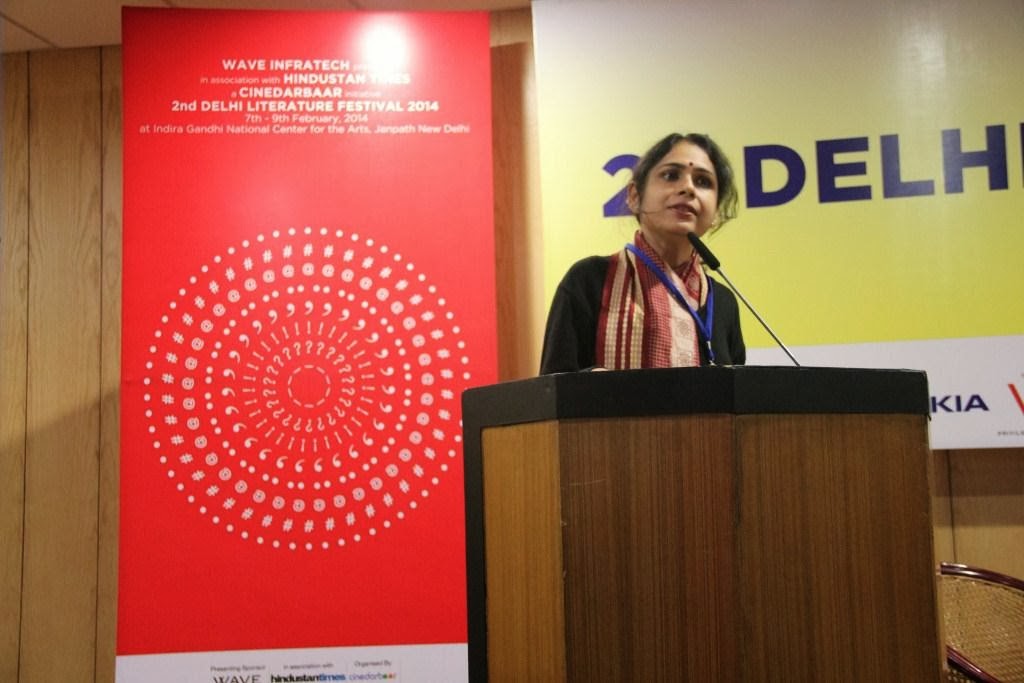
Photos of the Panel Discussion at Delhi Lit Fest 2014

Sangeeta Gupta, Shubha Sarma and Bhaskar Ghose enjoying Vandana Jena's remarks.

The panel discussion in full flow.


What have I said to bring a smile on the faces of the other panelists?


Bina Biswas, eminent author, asks a question about Fly on the Wall & Other Stories.


 Sharing a light moment with Bhaskar Ghose, Retired Secretary to Govt. Of India.


Thrilled to share the stage with Mrs.Vandana Kumari Jena, Secretary to Govt. of India


 All the panelists together. (L-R) Bhaskar Ghose, Sangeeta Gupta, Vandana Kumari Jena and Shubha Sarma.


With one of the organizers: Supriya Suri


Tuesday, 11 February 2014

Discussion at the Delhi Lit Fest 2014

The 2nd Edition of the Delhi Literary Festival, popularly known as Delhi Lit Fest (DLF), was recently held in Delhi. There were several discussions devoted to a wide variety of subjects. Given the large number of civil servants who have taken to writing, one session was devoted to the "Creative Pursuits of Civil Servants". The moderator was Mr.Bhaskar Ghose, who retired as Secretary to Government of India. I was part of the panel that also included Mrs.Vandana Kumari Jena, Secretary to Govt of India, Department of Land Records and Mrs.Sangeeta Gupta, Commissioner, Department of Income tax .
The session started at 11 am on 8 February, 2014 and despite it being a cold, overcast day, I was amazed to find a large number of people present in the auditorium. There were several others milling outside on the lawns, admiring the exhibits and book stalls.
The preliminary introductions were an eye opener. Mrs. Jena is a prolific writer, having penned more than 300 middles and a novel. Mrs. Gupta is a painter, writer and poetess, while Mr.Ghose has used his time after retirement to pen several books. Sharing the dais with such distinguished people made me feel extremely honoured.
Mr.Ghose flagged off the session by observing that there are 2 categories of civil servants. On a jocular note, he mentioned that after spending more than 30 years formulating categories and types for various government schemes, he could hardly desist from doing so today! Category A are those who write while in service, treading the fine line between work and passion, writing because one must and without compromising on the quality of work. And category B, are those who on attaining retirement, first write memoirs and then prescriptive books which express outrage against the system of which they are or were a part for several decades. My hunch is that he chose this line to open a discussion since all the other panelists were of category A and we would have bristled with anger if he had said anything else.
The discussion that followed felt decidedly au fait. Laments of being type-cast, branded or stereo-typed were heard from all speakers. The fear of being seen as a non-serious officer (since you preferred to write humorous middles, as Mrs.Jena did) or being seen as non-performing because you were not married to your work but had other interests, resulting in one trying to achieve double what others did (as Mrs.Gupta stated) were some of the observations.
An interesting nugget was shared by Mrs.Jena. She told the audience that as impressionable probationers, some well-meaning officer had advised them that with the passage of time, they should avoid metamorphosing into those driven to gasconade. Such persons are prone to starting every sentence with "When I was a DM/Collector…". To remain down-to-earth, it was suggested that one should cultivate and develop a hobby that one enjoys. Mrs.Jena modestly stated that since other art forms such as dance or music require some inherent talent, most people in her batch took to writing, since that was one skill that they were naturally adept at. And that is how she started on her voyage as an author.
As for my part, I happily admitted that for more than a decade I had remained a closet writer for fear of ridicule and being branded as the dreamy, writing-sorts. For in the IAS, writing is no longer considered the gold-dust that it used to be under its harbinger, the ICS. I remember that as a young officer, I found the earliest records of a district in the Gazetteers published by the British. Almost all of these were written by ICS officers. Apart from being treasure troves of information, these are delightful reads. Yet today, one thinks twice before disclosing one's alternate identity of being a cultural pretender.
On the whole, it was a delightful session where we took an unsuspecting audience by surprise and unburdened our heavy hearts on the travails of being a creative Civil Servant!